
Stainless Steel Jewelry Manufacturing: Why PVD Lasts
PVD is often sold as a colour, but it is really an adhesion method: metal is vaporised in a vacuum and deposited atom by atom onto the piece. That is why a PVD finish on 316L survives showers and swimming while a thin electroplated layer on the same shape may not. The published stainless route uses 316L with 2–3% molybdenum and a 100+ piece MOQ per design.
Key takeaways
- PVD deposits a film in a vacuum rather than from a liquid bath, so adhesion depends on surface preparation.
- 316L carries 2–3% molybdenum, which supports corrosion resistance in shower and pool exposure.
- Stainless starts at 100+ pieces per design, with sampling at 25–30 days and bulk at 3–4 weeks.
- Four compliance markers apply: ISO 9001:2015, BSCI, REACH and CA Prop 65.
What happens inside a PVD chamber
Physical vapour deposition takes a solid coating material, converts it to vapour and lets it condense on the jewelry surface. In a vacuum, the vapour travels in a straight line until it meets the substrate, so the film builds up atom by atom rather than as a wet layer that dries. There is no bath, no drag-out and no rinse water in the deposition step itself.
The consequence is a film that follows the surface it lands on. A polished face stays reflective; a brushed face keeps its direction; a textured face keeps its shadow. Electroplating can do something similar, but it throws into recesses and builds faster on edges, which is why a plated piece can look brighter at a corner than in a groove.
PVD is also a line-of-sight process, which sets its own limits. A surface the vapour cannot see will not be coated, so parts are fixtured and rotated during the cycle. Deep recesses and the inside of a closed ring need a plan, not an assumption, and that plan is part of the sample review.
Adhesion is a preparation problem
Most complaints about a coating flaking are really complaints about what happened before the chamber. Polishing residue, oil from handling, microscopic oxide and water trapped in a scratch all sit between the film and the metal. A PVD film formed over contamination adheres to the contamination, not to the steel.
That is why the published eight-step sequence puts polishing and surface art ahead of electroplating. For stainless, the same logic applies with PVD in the coating slot: the surface has to be finished and clean before coating, and the handling between those steps matters as much as the coating itself.
A second adhesion factor is heat. PVD processes run at elevated temperature, and a thin-walled piece can distort if the geometry is marginal. A design with a narrow wall and a wide flat face is more exposed than a solid band. The sample stage is where that shows up, because a distorted piece will not sit flat on a tray after coating.
Why 316L, and where the coating stops
The published distinction is clean. 316L contains 2–3% molybdenum, is described as waterproof, shower-safe and swim-proof, and is the grade that takes PVD most readily. 304 is water-resistant for daily wear, nickel and lead safe, and vacuum-plated for cost-effective volume. Neither is a decorative label; they are different alloys with different exposure limits.
Molybdenum improves resistance to chloride attack, which is the chemistry behind salt water and chlorinated pools. A 316L piece is not indestructible, but the alloy gives the coating a stable substrate in conditions where a lower grade would pit. For a brand selling a "wear it in the shower" promise, the alloy choice is part of the claim, not a footnote.
Price follows the same line. 304 is the volume option, and a brand that switches to 316L for every SKU pays for corrosion resistance it may not need. The sensible split is 316L for pieces marketed on daily wear and water exposure, 304 for fashion pieces where the finish matters more than the alloy.
The two routes, with the published 100+ piece floor, are set out by this stainless steel jewelry supplier China page, which also covers the finish options for each grade.
| Route | How it is applied | Typical substrate | Wear behaviour |
|---|---|---|---|
| PVD vacuum plating | Vaporised metal condensed in a vacuum | 316L, 304 stainless | Resists shower and pool exposure |
| Electroplating | Metal deposited from a liquid bath | Sterling silver, brass | Even colour, softer under abrasion |
| Anti-tarnish e-coat | Protective coating over plated metal | Silver, brass | Slows sulphur tarnish |
| Uncoated polish | Mechanical finish only | Any metal | Shows scratches and patina |
A coating is a surface, not a structural repair. PVD will not hide a porosity pit that opens during polishing, and it will not stop a crack that starts at a thin wall. Those faults are decided at casting and polishing, and coating them only delays the failure until the piece is in a customer's hand.
PVD also does not make a piece scratch-proof. A sharp impact can penetrate the film and expose the alloy beneath, and once exposed, the contrast between coating and substrate is visible. The realistic claim is resistance under normal wear, not immunity. Brands should describe the finish in those terms and let the alloy do the rest.
Repair is the other limit. A polished silver piece can be re-polished and re-plated locally; a PVD-coated stainless piece usually cannot be spot-repaired without stripping the whole surface. That makes the coating a one-way finish, which is fine for a production line and awkward for a repair counter.
The compliance stack behind a coated piece
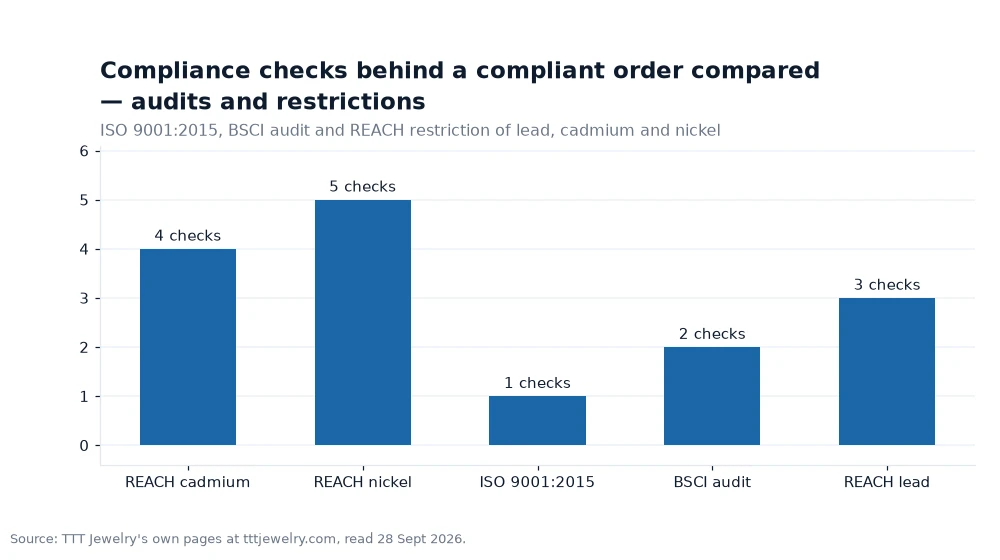
Four published markers sit behind a compliant order: ISO 9001:2015 for quality management across production stages, BSCI for labour and social audit, REACH compliance for lead, cadmium and nickel, and plating that is 100% compliant with REACH and CA Prop 65. For a stainless supplier shipping into Europe or California, the last two are the ones a buyer's compliance team will ask about first.
Nickel is the sensitive one for jewelry. REACH restricts nickel release from items in prolonged skin contact, and a stainless piece that contains nickel in the alloy still has to meet the release rule. The published position is that materials are free of lead, cadmium and nickel; the buyer's job is to keep that statement attached to the specific order, not just to the catalogue.
ISO 9001:2015 is the process marker that makes the others auditable. It does not certify a finish, but it documents the stages where the finish is controlled. When a compliance questionnaire arrives, a factory with a documented flow can answer it with records rather than assurances.
Worked example
Take three designs at the stainless floor: 3 × 100 = 300 pieces. If each design is offered in two PVD colours, the programme needs 3 × 2 = 6 finish variants, and six sequential sample rounds at 25–30 days would run 150–180 days. Running variants in parallel inside one 25–30 day window keeps the calendar at 3.6–4.3 weeks.
The full lead time is shorter than that sequential figure suggests. CAD is 2 days, sampling 25–30 days, bulk 21–28 days, giving 2 + 25–30 + 21–28 = 48–60 days, or roughly 7–9 weeks. The finish variants share the sampling window; the bulk run does not.
Compliance paperwork scales with designs rather than pieces. Five published checks across three designs is 15 answers to prepare, while the same five checks across 300 pieces is still 15. That is why a brand adding a fourth design should expect more administrative work, not just a larger plating bill.
Frequently asked questions
Is PVD the same as gold plating?
No. PVD deposits a film in a vacuum, while gold plating deposits metal from a wet bath. On stainless, PVD is the published route for a durable colour finish.
Can PVD jewelry be worn in the shower?
316L is published as waterproof, shower-safe and swim-proof, and it is the grade described as taking PVD most readily. The alloy and the coating both contribute.
What is the minimum order for a PVD stainless design?
100+ pieces per design is the published stainless MOQ. Brass starts at 100 pieces and sterling silver at 50 per design.
Specifying a finish that survives the claim
The useful question is not whether PVD lasts, but which claim the piece is expected to support. A fashion pendant that leaves the box for an evening needs a different specification from a ring worn through a swimming pool. Writing the use case into the brief tells the factory which alloy, which surface preparation and which coating route to quote.
The finishing options sit inside a wider customisation menu published by TTT Jewelry, where plating, stones, hallmarks and packaging are listed as separate decisions. The sterling silver jewelry manufacturer route is worth reading alongside it for any collection that mixes steel and silver, because the two metals reach a gold tone by different methods.
A coating is only as good as the surface under it and the claim above it. Match the alloy to the exposure, prepare the surface, and describe the result in the same terms the factory uses. That is what makes a finish last in a customer's mind as well as on the piece.
Source note: figures come from the manufacturer's own website (tttjewelry.com), read 28 Sept 2026.[1]